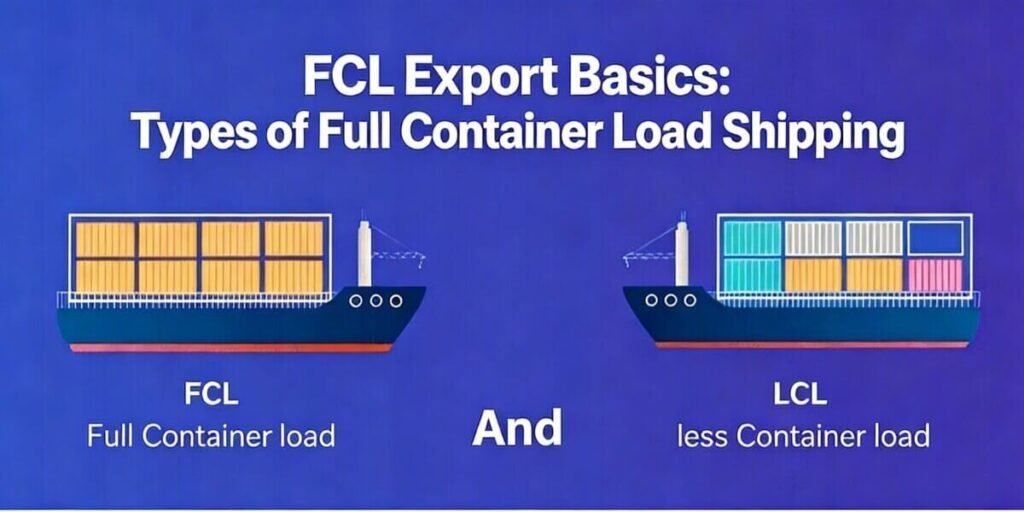
Choosing between FCL and LCL shipping can make a significant difference in your overall logistics cost. Many shippers assume that LCL is always cheaper, but in reality, the answer depends on your cargo volume, shipping route, and timing.
In ocean freight, selecting the wrong option could lead to higher hidden fees, longer transit times, and unnecessary delays. That’s why understanding the true cost difference between FCL and LCL is critical for businesses aiming to stay competitive.
This guide will help you compare FCL vs LCL shipping costs, benefits, and best-use scenarios, so you can reduce expenses and improve your shipping efficiency.
What Is FCL in Shipping? (Full Container Load Explained)
FCL Meaning and Definition
FCL (Full Container Load) refers to a shipping method where one shipper uses an entire container exclusively for their cargo. In ocean freight, this means the container is loaded, sealed, and transported without being shared with other shipments.
FCL is commonly used when the shipment volume is large enough to fill a container or when cargo safety and efficiency are a priority. Since the container is not opened or consolidated with other goods during transit, it reduces the risk of damage, loss, or delays.
Compared to shared shipping methods, FCL offers more predictable transit times and simpler handling, making it a preferred option for bulk shipments, high-value goods, and time-sensitive deliveries.
How FCL Shipping Works
Full Container Load (FCL) shipping is a method where one shipper uses an entire container exclusively for their cargo. The process starts with booking a container through a freight forwarder or carrier. Once confirmed, the container is delivered to the shipper’s warehouse for cargo loading, or goods are sent to a designated container yard for stuffing.
After loading, the container is sealed and transported to the port of origin for customs clearance. It is then loaded onto a vessel for ocean freight. Since the container remains sealed throughout transit, the risk of damage, loss, or contamination is significantly reduced.
Upon arrival at the destination port, the container goes through import customs clearance and is delivered directly to the consignee for unloading. FCL shipping is ideal for large-volume shipments, offering faster transit times, better cargo security, and more predictable shipping costs.
Advantages of FCL Shipping
Full Container Load (FCL) shipping offers several key advantages for businesses handling large-volume cargo. Since the entire container is used by a single shipper, it provides enhanced cargo security and minimizes the risk of damage or contamination from other shipments.
FCL shipping also ensures faster transit times, as there is no need for cargo consolidation or deconsolidation. This makes it a preferred option for time-sensitive shipments in international logistics and ocean freight.
In addition, FCL provides more predictable shipping costs, as pricing is based on a full container rather than shared space. It becomes more cost-effective when shipping large quantities of goods.
Overall, FCL shipping is ideal for businesses seeking reliable, secure, and efficient container shipping solutions for bulk cargo.
Disadvantages of FCL Shipping
While FCL (Full Container Load) shipping is efficient for large shipments, it may not always be the most suitable option for every business. Understanding its disadvantages can help shippers make better logistics decisions.
One of the main drawbacks of FCL shipping is the high upfront cost. Shippers must pay for the entire container, even if it is not fully loaded. This makes it less cost-effective for small or medium-sized shipments, as the cost per unit increases when space is unused.
Another limitation is reduced flexibility. FCL requires sufficient cargo volume to justify a full container. If shipment volumes fluctuate, businesses may face delays while waiting to consolidate enough goods or end up wasting container space.
FCL shipping also involves longer preparation and planning time. Booking a container, arranging loading, and handling documentation require coordination, which may slow down the shipping process, especially for urgent deliveries.
In addition, there are extra logistics costs to consider. Inland transportation, terminal handling charges, and possible storage or demurrage fees can increase the total shipping cost if not managed properly.
Finally, FCL may not be ideal for businesses that need fast and flexible delivery options. In such cases, alternatives like LCL (Less than Container Load) or air freight may offer better efficiency.
By understanding these disadvantages, businesses can choose the most cost-effective and practical shipping method based on their needs.
What Is LCL in Shipping? (Less than Container Load Explained)
Definition of LCL in Ocean Freight
LCL (Less than Container Load) in ocean freight is a shipping method where multiple shipments from different exporters are combined into a single container. Instead of paying for a full container, each shipper is charged based on the volume or weight of their cargo, making LCL shipping a cost-effective solution for smaller shipments.
In the LCL shipping process, cargo is first delivered to a consolidation warehouse, where it is grouped with other shipments heading to the same destination. The consolidated container is then shipped by sea to the destination port. Upon arrival, the container is unloaded, and each shipment is separated and delivered to its respective consignee. This process is typically managed by freight forwarders who handle documentation, customs clearance, and coordination.
One of the key features of LCL in ocean freight is its flexibility. Businesses can ship goods without waiting to accumulate enough volume for a full container, which helps improve inventory turnover and cash flow. This is particularly beneficial for small and medium-sized enterprises (SMEs) or companies with irregular shipping needs.
However, due to the shared nature of LCL shipments, there are additional handling steps involved, including consolidation and deconsolidation. These extra processes may slightly increase transit time and the risk of delays compared to FCL (Full Container Load) shipping.
Overall, LCL shipping plays an important role in global ocean freight by providing an accessible and economical option for businesses that do not require a full container, while still benefiting from international shipping networks.
How LCL Shipping Works
LCL (Less than Container Load) shipping follows a structured process that allows multiple shipments from different exporters to share space within a single container. This method is widely used in ocean freight for small and medium-sized cargo that does not require a full container.
The process begins with the shipper delivering goods to a consolidation warehouse operated by a freight forwarder. At this stage, cargo is inspected, measured, and prepared for shipment. Each shipment is then grouped with other goods heading to the same destination, ensuring efficient use of container space.
Once enough cargo is collected, the freight forwarder arranges container consolidation, where all shipments are loaded into one container. The container is then sealed and transported to the port for export customs clearance before being loaded onto a vessel for international shipping.
During transit, the container follows standard ocean freight routes to the destination port. Upon arrival, it undergoes import customs clearance, after which the container is moved to a deconsolidation warehouse. Here, the cargo is unloaded and separated according to individual consignees.
Finally, each shipment is either picked up by the consignee or delivered via last-mile transportation services. Throughout the process, freight forwarders manage documentation, tracking, and coordination to ensure smooth delivery.
Although LCL shipping involves more handling steps compared to FCL (Full Container Load), it offers greater flexibility and cost efficiency for businesses with smaller shipment volumes. This makes it a practical and widely used solution in global logistics and international trade.
Advantages of LCL Shipping
LCL (Less than Container Load) shipping offers several advantages for businesses that do not have enough cargo to fill a full container. It is a flexible and cost-efficient solution widely used in global ocean freight.
One of the primary benefits of LCL shipping is lower shipping costs. Since multiple shippers share a single container, each party only pays for the space their cargo occupies. This makes LCL an ideal option for small and medium-sized shipments, helping businesses reduce overall logistics expenses.
Another key advantage is high flexibility. LCL allows companies to ship goods without waiting to accumulate enough volume for a full container. This enables more frequent shipments, improves inventory management, and supports better cash flow—especially for businesses with fluctuating or seasonal demand.
LCL shipping also provides global accessibility. Freight forwarders offer extensive consolidation services across major trade routes, making it easier for businesses to reach international markets without requiring large shipment volumes. This is particularly beneficial for small and medium-sized enterprises (SMEs) entering global trade.
In addition, LCL reduces the need for large storage space. Businesses can ship smaller quantities more frequently instead of holding large amounts of inventory, which helps lower warehousing costs and minimize stock risks.
Finally, LCL shipping offers greater convenience through professional logistics support. Freight forwarders handle consolidation, documentation, customs clearance, and delivery coordination, allowing businesses to focus on their core operations.
Overall, LCL shipping is a practical and efficient solution for companies seeking cost savings, flexibility, and access to international shipping without committing to a full container load.
Disadvantages of LCL Shipping
While LCL (Less than Container Load) shipping is a flexible and cost-effective solution for smaller shipments, it also comes with several drawbacks that businesses should consider when planning their logistics strategy.
One of the main disadvantages of LCL shipping is longer transit time. Because shipments need to be consolidated at the origin and deconsolidated at the destination, the overall process involves more steps compared to FCL (Full Container Load) shipping. These additional handling stages can lead to delays, especially during peak shipping seasons.
Another key limitation is the higher risk of cargo damage or loss. Since goods from multiple shippers are packed into the same container, cargo is handled more frequently during loading and unloading. This increases the possibility of mishandling, especially for fragile or high-value goods.
LCL shipping may also result in unexpected additional charges. Costs such as consolidation fees, deconsolidation charges, terminal handling charges (THC), and documentation fees can add up, making the total cost less predictable than initially expected.
In addition, there is less control over shipping schedules. LCL shipments depend on container consolidation timelines, meaning your cargo may need to wait until enough goods are collected to fill a container. This can reduce flexibility for time-sensitive shipments.
Finally, LCL is not always ideal for large or high-volume cargo. As shipment size increases, the cost per unit for LCL can become higher than FCL, making it less economical for bigger shipments.
Overall, while LCL shipping offers flexibility and lower upfront costs, businesses should carefully evaluate these disadvantages to determine whether it aligns with their shipping needs and timelines.
FCL vs LCL: Key Differences You Need to Know
When choosing between FCL (Full Container Load) and LCL (Less than Container Load), understanding the key differences is essential for optimizing your shipping strategy. Both methods are widely used in ocean freight, but they vary significantly in terms of cost, transit time, cargo safety, and flexibility. Selecting the right option depends on your shipment size, budget, and delivery timeline
Cost Comparison: FCL vs LCL
Cost is a critical factor when comparing FCL and LCL shipping. FCL requires paying for an entire container, which means higher upfront costs. However, for large shipments, the cost per unit is lower, making it more economical for bulk cargo.
In contrast, LCL shipping allows businesses to pay only for the space used, making it ideal for smaller shipments. However, additional charges such as consolidation fees, terminal handling charges (THC), and documentation costs can increase the overall shipping expense. For growing shipment volumes, LCL may eventually become less cost-effective than FCL.
Transit Time Differences
FCL shipping generally offers faster and more predictable transit times. Since the container is dedicated to one shipper, it moves directly from origin to destination with minimal handling or delays.
LCL shipping, on the other hand, involves cargo consolidation and deconsolidation, which adds extra time to the shipping process. Delays may occur while waiting for enough cargo to fill a container or during sorting at destination warehouses. Therefore, LCL is less suitable for urgent or time-sensitive shipments.
Cargo Safety and Risk Comparison
FCL shipping provides greater cargo security because the container is sealed after loading and remains unopened until it reaches the final destination. This reduces handling and lowers the risk of damage, loss, or contamination.
In comparison, LCL shipments involve multiple handling stages, increasing the risk of cargo damage or misplacement. Since goods from different shippers are packed together, proper packaging and labeling are essential to minimize risks.
Flexibility and Shipment Size
LCL shipping offers greater flexibility, allowing businesses to ship smaller volumes without waiting to fill a full container. This helps improve inventory turnover and cash flow, making it a preferred option for small and medium-sized businesses.
FCL shipping is better suited for large and consistent shipment volumes. While it requires more cargo to be cost-effective, it provides better control over shipping schedules and overall logistics efficiency.
When Should You Choose FCL vs LCL?
Choosing between FCL (Full Container Load) and LCL (Less than Container Load) depends on several key factors, including shipment volume, budget, delivery timeline, and cargo type. Understanding when to use each method can help businesses optimize shipping costs and improve logistics efficiency.
Best Scenarios for Choosing FCL
FCL shipping is the best option when you have large shipment volumes that can fill or nearly fill an entire container. It offers lower cost per unit and better overall efficiency for bulk cargo.
It is also ideal for high-value or fragile goods, as FCL reduces handling and minimizes the risk of damage or contamination.
It is also ideal for high-value or fragile goods, as FCL reduces handling and minimizes the risk of damage or contamination.
Best Scenarios for Choosing LCL
LCL shipping is ideal for small and medium-sized shipments that do not justify the cost of a full container. It allows businesses to pay only for the space they use.
It is also suitable for businesses that require flexible shipping schedules, as LCL enables more frequent shipments without waiting to accumulate large volumes.
LCL is especially beneficial for startups and SMEs entering international trade, as it reduces upfront logistics costs and inventory pressure.
Break-Even Point: When LCL Becomes More Expensive
Although LCL is cost-effective for small shipments, there is a break-even point where it becomes more expensive than FCL. This typically occurs when cargo volume reaches around 10–15 cubic meters (CBM), depending on the shipping route and pricing structure.
This is because LCL includes additional charges such as consolidation fees, handling costs, and documentation fees, which increase as shipment volume grows.
At this stage, switching to FCL can provide better cost efficiency, faster transit time, and improved cargo safety.
FCL vs LCL Cost Breakdown (Hidden Fees Explained)
When comparing FCL vs LCL shipping costs, it is important to look beyond the base freight rate. Many businesses underestimate the total logistics cost by ignoring additional charges such as port fees, handling costs, and documentation expenses. Understanding the full cost structure helps avoid unexpected fees and improves budgeting accuracy.
FCL Shipping Cost Structure
FCL (Full Container Load) shipping typically offers a more predictable pricing model, as costs are based on a full container rather than cargo volume. However, the total cost still includes multiple components across the shipping process.
Key cost components of FCL shipping include:
Ocean Freight (Flat Container Rate)
The primary cost of shipping, charged per full container.
Origin Charges
Fees at the port of origin, including Terminal Handling Charges (THC), container loading, and export handling.
Destination Charges
Costs incurred at the destination port, including unloading, terminal handling, and local agent fees.
Customs Clearance Fees
Charges for customs declaration, documentation processing, and import/export clearance.
Inland Transportation (Trucking or Rail)
Costs for transporting the container between the port and the final destination via truck or rail.
LCL Shipping Cost Structure
LCL (Less than Container Load) shipping has a more complex pricing structure compared to FCL, as costs are calculated based on cargo volume (CBM) or weight, whichever is higher. Because multiple shipments share the same container, additional handling and coordination are required, which can increase overall costs.
Key cost components of LCL shipping include:
Ocean Freight (per CBM or Weight)
The main shipping cost, calculated based on the cargo volume (cubic meters) or weight, depending on the carrier’s pricing rules.
Origin Charges (Consolidation Fees)
Fees at the port of origin for consolidating cargo, including warehouse handling, cargo receiving, and container loading.
Destination Charges (Deconsolidation Fees)
Costs at the destination port for unloading and separating cargo, including terminal handling and distribution.
Warehouse Handling Fees
Charges for loading, unloading, storage, and handling of goods at consolidation warehouses.
Customs Clearance and Documentation Fees
Expenses related to customs declaration, paperwork, and compliance requirements.
Common Hidden Charges in Ocean Freight
When comparing FCL and LCL shipping costs, many businesses focus only on the base ocean freight rate. However, hidden charges in ocean freight can significantly increase the total logistics cost if not clearly understood in advance. These additional fees may arise at the origin, during transit, or at the destination.
Port and Terminal Charges
Terminal Handling Charges (THC)
Fees for loading and unloading containers at the port.
Port Congestion Surcharge
Additional charges applied during periods of port congestion.
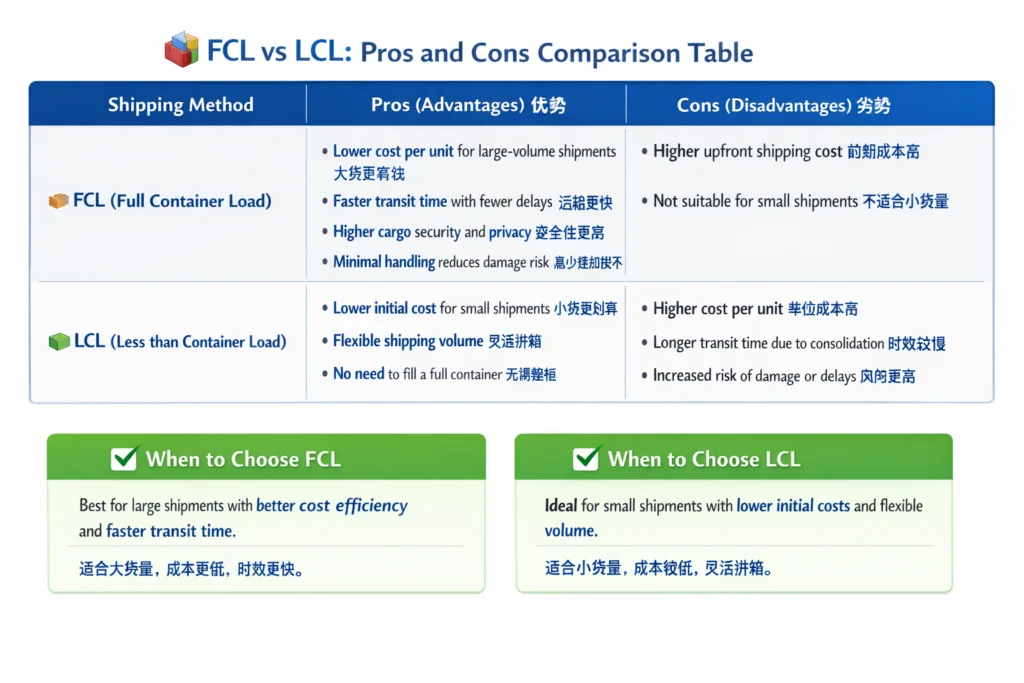
Pros and Cons of FCL vs LCL (Quick Summary Table)
FCL Pros and Cons
FCL (Full Container Load) shipping is one of the most efficient and widely used freight methods in international logistics, especially for large-volume shipments. Understanding the advantages and disadvantages of FCL shipping can help businesses make better decisions, reduce costs, and improve supply chain efficiency.
Advantages of FCL Shipping
FCL shipping offers significant cost advantages when transporting large volumes of goods. Since you are paying for the entire container, the cost per cubic meter is much lower compared to LCL shipping when the container is fully utilized.
Another key advantage is faster transit time. FCL shipments are not subject to consolidation or deconsolidation processes, which means cargo can be shipped directly from origin to destination with fewer delays.
FCL also provides better cargo security. The container is sealed at the origin and remains closed until it reaches the destination, minimizing handling and reducing the risk of damage, theft, or contamination.
Additionally, FCL shipping allows for better control over loading and packaging. Shippers can organize goods more efficiently and ensure proper handling standards are maintained.
Disadvantages of FCL Shipping
Despite its advantages, FCL shipping comes with higher upfront costs. Businesses are required to pay for the entire container regardless of how much cargo is loaded, which can be inefficient for smaller shipments.
Another limitation is that FCL is not suitable for low-volume shipments. If the container is not fully utilized, the cost per unit increases, reducing overall cost efficiency.
FCL shipping may also require more storage space and inventory planning, as businesses often need to accumulate enough goods to fill a container before shipping.
In some cases, longer preparation time may be needed before shipment, especially when waiting to consolidate enough cargo internally.
LCL Pros and Cons
LCL (Less than Container Load) shipping is a flexible and cost-effective solution for businesses that do not have enough cargo to fill an entire container. It is widely used by small and medium-sized enterprises, especially in cross-border e-commerce and trial shipments. Understanding the pros and cons of LCL shipping can help businesses optimize logistics strategies and control shipping costs.
Advantages of LCL Shipping
One of the main advantages of LCL shipping is its lower upfront cost. Shippers only pay for the space they use within a shared container, making it an affordable option for small-volume shipments.
LCL also offers greater flexibility, allowing businesses to ship goods more frequently without waiting to accumulate enough cargo for a full container. This improves supply chain responsiveness and reduces inventory pressure.
In addition, LCL shipping is ideal for sample shipments, trial orders, and market testing. It enables businesses to enter new markets with lower risk and investment.
Another benefit is reduced storage requirements, as companies do not need to stockpile goods to fill a full container before shipping.
Disadvantages of LCL Shipping
One of the biggest disadvantages of LCL shipping is the higher cost per cubic meter compared to FCL. Although the initial cost is lower, the overall unit shipping cost is usually higher.
LCL shipments also involve longer transit times due to the need for cargo consolidation and deconsolidation at origin and destination warehouses. This process can add delays to the overall shipping time.
Another drawback is the increased risk of damage or loss. Since multiple shipments from different shippers are combined in one container, cargo is handled more frequently, increasing the chance of damage.
In addition, customs clearance for LCL shipments can be more complex, as each shipment may require separate documentation and inspection. Delays affecting one shipment can sometimes impact others in the same container.
Conclusion: FCL vs LCL – Which Shipping Option Is Right for You?
In summary, understanding the difference between FCL and LCL shipping is essential for choosing the most efficient and cost-effective freight solution for your business. FCL shipping is ideal for large-volume shipments that require faster transit times, better cargo security, and predictable pricing, while LCL shipping offers flexibility and lower upfront costs for smaller shipments that do not fill an entire container.
When deciding between FCL vs LCL, factors such as shipment volume, budget, delivery urgency, and cargo type should all be carefully considered. Businesses that ship regularly or in bulk may benefit more from FCL freight, whereas small and medium-sized enterprises or e-commerce sellers often find LCL shipping to be a more practical choice.
Ultimately, selecting the right shipping method can help you reduce logistics costs, improve supply chain efficiency, and minimize risks. If you are unsure which option suits your needs best, working with an experienced freight forwarder can help you optimize your international shipping strategy and ensure smooth delivery from origin to destination.